What Is PICSI?
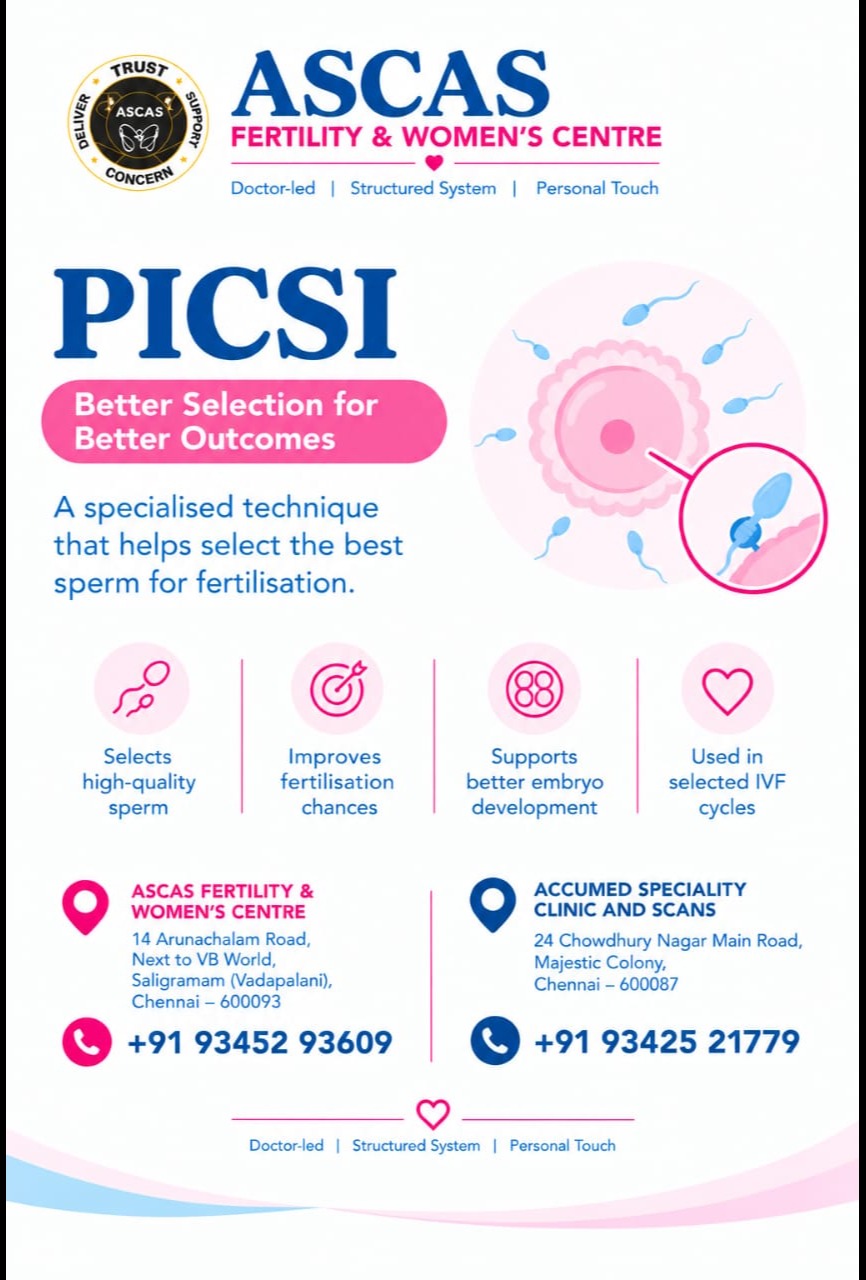
PICSI (Physiological Intracytoplasmic Sperm Injection) is an additional sperm-selection technique used in some IVF treatments. It uses the ability of sperm to bind to hyaluronic acid (HA), a substance naturally present around the egg's outer covering, to help embryologists select sperm for intracytoplasmic sperm injection (ICSI).
PICSI provides an additional method of sperm selection alongside routine laboratory assessment. It is not necessary or beneficial for every IVF patient.
How Does PICSI Work?
*The PICSI procedure generally involves the following steps:
Semen sample preparation: The sample is processed to obtain suitable motile sperm.
*Hyaluronic acid binding: Sperm are placed in a specialised dish containing hyaluronic acid.
*Sperm selection: Embryologists identify sperm that bind to the hyaluronic acid.
*ICSI procedure: A selected sperm is injected directly into a mature egg under microscopic guidance.
*Embryo assessment: The resulting embryos are monitored according to standard IVF laboratory procedures.
Why Is PICSI Considered?
PICSI may offer an additional approach to sperm selection by:
Identifying sperm capable of binding to hyaluronic acid.
Supporting the embryologist's sperm-selection process.
Providing an alternative selection method in appropriately selected IVF cases.
Complementing the overall assessment of sperm and reproductive history.
Important: Although PICSI offers a physiological approach to sperm selection, evidence that it consistently improves pregnancy or live-birth rates is limited. Its suitability should be discussed with the fertility specialist.
Who May Benefit from PICSI?
PICSI may be discussed as an option for selected patients undergoing IVF with ICSI, depending on their clinical history and treatment needs.
The decision may consider factors such as:
*Previous IVF or ICSI outcomes.
*Semen analysis findings.
*Relevant reproductive history.
*The potential benefits, limitations and cost of additional sperm-selection techniques.
*PICSI is not a substitute for a complete male fertility evaluation, and sperm binding alone does not guarantee normal fertilisation, embryo development or pregnancy.
The Role of Your Fertility Specialist and Embryology Team
At ASCAS Fertility & Women’s Centre, fertility treatment is planned according to each patient's individual needs and clinical findings.
Dr. Aishwarya Parthasarathy
Consultant Fertility Specialist & Gynaecologist
The fertility specialist reviews the couple's reproductive history, evaluates available test results and discusses appropriate treatment options. The embryology team performs the laboratory procedures and assesses sperm and embryo development according to established protocols.
Together, the team helps patients make informed decisions about their fertility treatment.
Frequently Asked Questions
1. Is PICSI different from conventional ICSI?
Yes. In conventional ICSI, an embryologist selects a sperm using microscopic assessment. PICSI adds a hyaluronic-acid-binding step to assist sperm selection before injection.
2. Does PICSI guarantee better fertilisation?
No. PICSI does not guarantee fertilisation, embryo development, pregnancy or live birth. Outcomes depend on several factors, including egg quality, sperm characteristics and individual clinical circumstances.
3. Is PICSI suitable for every IVF patient?
No. It is an additional laboratory technique, and its use should be individualised after discussing the available evidence, limitations and costs.
4. Does PICSI replace semen analysis?
No. Semen analysis and the overall male fertility assessment remain important. PICSI is an additional selection technique used in specific IVF laboratory settings.
Consult Our Fertility Team
ASCAS Fertility & Women’s Centre
14 Arunachalam Road, Next to VB World, Saligramam (Vadapalani), Chennai – 600093
Phone: +91 93452 93609
Accumed Speciality Clinic & Scans
24 Chowdhury Nagar Main Road, Majestic Colony, Chennai – 600087
Phone: +91 93425 21779
ASCAS Fertility & Women’s Centre
Doctor-led • Structured System • Personal Touch
Keywords